Best Acoustic Panels for an Echoey Home Office
Fix an echoey home office the right way: why cheap foam often fails, when wood-slat panels win, and where to place them for clean audio.
The best acoustic panels for a home office are the ones that solve the real problem, and in a bare, echoey room that problem is rarely the one people buy for. Hard walls, a hard floor and a hard desk bounce your voice around until every video call and recording sounds hollow and distant. Fixing that is cheaper and simpler than the marketing suggests, as long as you treat the right surfaces with the right kind of panel.
Do you need treatment or soundproofing?
This is the distinction that decides whether your money is well spent. Soundproofing blocks sound from travelling between rooms, and it needs mass and structural decoupling: thick walls, isolation clips, resilient bars. Acoustic treatment (absorbing and scattering the reflections bouncing around inside a room) is a different job, and it is what tames echo and reverberation (the lingering wash of sound after you stop speaking).
An echoey office is a treatment problem, almost never a soundproofing one. The single most common creator mistake is buying "soundproofing foam" to stop echo, then wondering why the room still sounds boxy. Absorbing reflections inside the room will not stop your neighbour's drill, and no amount of foam will either. If the issue is the slap-back you can hear between two bare parallel walls (flutter echo), treatment is exactly what you need.
Why does cheap acoustic foam often disappoint?
The human voice lives mostly between 200 Hz and 4 kHz, and that band is where a home office needs the most help. Thin, cheap acoustic foam absorbs enthusiastically above about 500 Hz but does far less in the 200 to 800 Hz range where your voice carries its body and warmth. The result is a recording that sounds thin and papery rather than genuinely controlled.
Foam is also weak on lower frequencies, so it does little for the boomy build-up in a small room. A useful buying spec here is the Noise Reduction Coefficient (NRC, a single 0 to 1 rating of how much sound a material absorbs, where higher is better). Read it carefully, though, because a headline NRC can hide weak performance in exactly the low-mid range voices depend on.
When are wood-slat panels the better buy?
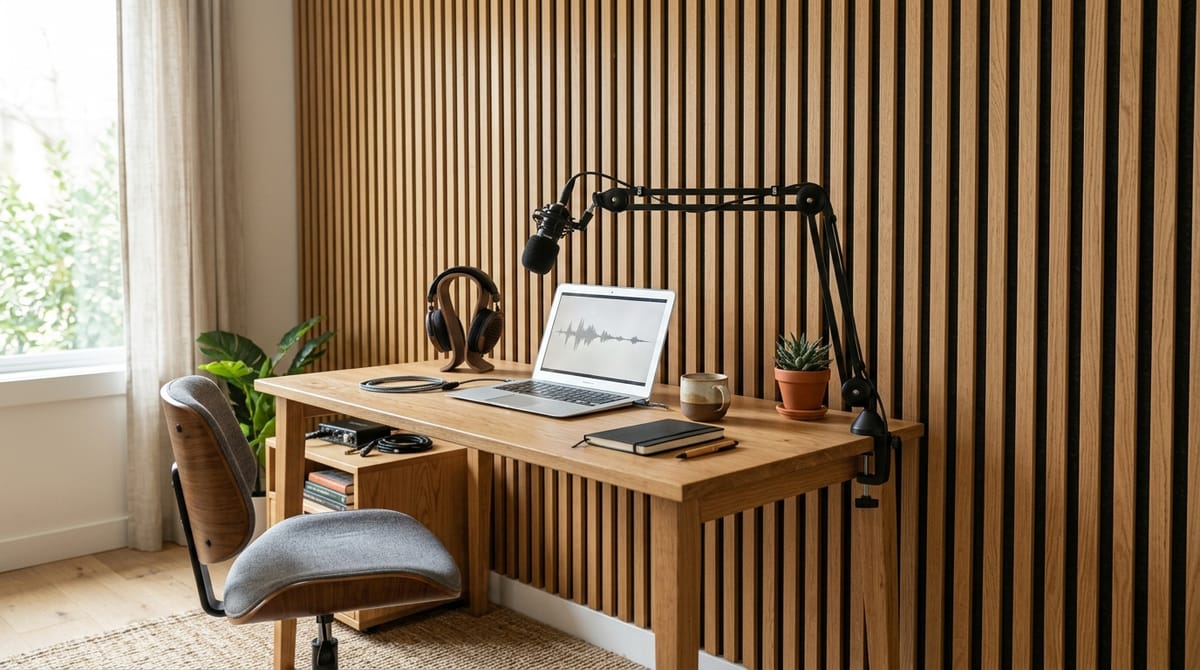
A wood-slat acoustic panel (wooden veneer slats mounted over a layer of acoustic felt on a backing board) is the upgrade most on-camera creators actually want. The felt behind the slats absorbs the mid and high frequencies that matter for voice roughly as well as foam does, while the slats scatter some sound rather than only soaking it up, which keeps a treated room sounding natural rather than dead.
The decisive advantage is on camera. Foam tiles read as an amateur bedroom-studio look, whereas a slat wall behind you looks like a designed, deliberate backdrop. For a talking-head setup that means one purchase doing two jobs: echo control and set design. That dual role is why felt-backed slat panels have become the default creator-wall upgrade in UK home offices and podcast corners.
What about broadband absorbers?
If your priority is the best possible sound rather than the best backdrop, a broadband absorber (a thicker mineral-wool or fibreglass panel, usually 5 to 10 cm deep, that absorbs across a wide frequency range including the lower mids) outperforms both foam and slat panels on raw acoustic control. These are the panels you see in professional vocal booths, often placed at first reflection points and stacked into room corners as bass traps.
The trade-offs are look and space. A fabric-wrapped broadband panel is bulkier and less decorative than a slat wall, so it suits a dedicated recording corner more than a video backdrop. Plenty of creators mix the two: broadband panels where the camera never looks, slat panels on the wall that it does.
| Acoustic foam | Wood-slat panels | Broadband absorbers | |
|---|---|---|---|
| Best for | Hidden mic corners and booths on a budget | On-camera creators wanting echo control plus a backdrop | The strongest acoustic control in a dedicated corner |
| Voice range (200 Hz to 4 kHz) | Absorbs highs well, weaker in the low-mids | Felt backing absorbs mids and highs, slats add diffusion | Best across the range, including lower mids |
| On camera | Reads amateur, so keep it out of shot | Looks designed and professional | Bulky and utilitarian, so hide from shot |
| Relative cost | Lowest | Mid to high | Highest per panel |
How many panels do you need, and where?
Placement matters far more than quantity, and this is where most people overspend. The priority surfaces are the first reflection points: the spots on the side walls, at roughly ear height, where sound bounces once on its way from your mouth to the microphone or from a speaker to your ears. Treating those points, plus the wall behind your camera, removes most of the audible echo.
A sensible starting point for a small office is the wall behind the camera plus the nearest side-wall reflection point, then listen back and add more only if you need it. Resist the urge to cover every surface. A fully papered room over-absorbs, strips the natural life out of a voice and ends up sounding unnervingly flat and dead. You are aiming for controlled, not silent.
What should you look for when buying?
Felt or mineral-wool backing
The absorbing layer does the work. Slats over solid board with no felt behind them are decoration, not treatment.
A published absorption figure
Prefer panels that state an NRC or absorption rating. Treat a bare "soundproof" claim with suspicion.
Enough depth for your problem
Thicker panels absorb lower frequencies. A 9 mm decorative panel and a 50 mm broadband absorber are not the same tool.
Coverage matched to the room, not the whole wall
Buy for the first reflection points and the camera wall first. You can always add panels; over-treating is harder to undo.
Renter-friendly mounting
If you cannot drill, look for panels light enough for heavy-duty adhesive strips or a freestanding frame, so you protect your deposit.